Why a door closer will not fully close?
A door closer plays a major role in how a building operates. Although its primary function is to ensure a door closes after it has been opened, it also brings a range of benefits in terms of safety, compliance, security, energy efficiency and accessibility. Door closers are now incorporated into interior design schemes as an essential feature, for all these reasons, and therefore they help in how a building manages traffic flow and the general operations of the building. For this reason it is important that door closers are consistent and operate properly, but some common problems prevent this.
The most common problem with a door closer is that it prevents the door from fully closing. This can be caused by a number of different reasons, and presents problems in terms of possible issues with security, energy efficiency and fire safety compliance. So let’s look at the possible reasons why a door closer may not fully close a door.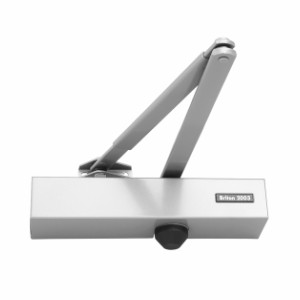
Overhead door closers are the most common type of door closer, but most designs have similar features whereby you can control the closing speed and the latching speed. This means you can adjust the valves in the mechanism to turn them clockwise or anti-clockwise to slow down or speed-up the closing action. This is usually done to suit the level of traffic using a door and to suit the general traffic flow and operations of the building. What is more commonly the issue with the door fully closing, however, is the latching speed. If a door closes too slowly it sometimes doesn’t have sufficient force to overcome the resistance presented by a door latch. This is the mechanism in the door handle itself, which when engaged will hold and maintain a door in the closed position and doesn’t enable it to drift open again. The latching speed can also be controlled in a door closer. This is adjusted by turning the latching valve, usually marked with an ‘L’, and this will increase or decrease the speed of the last few degrees of the closing cycle, known as the latching cycle. This can be done in small increments in a trial-and-error process, until the right speed is found. So a door can be closing quite quickly, or too slowly, but the latching speed can then control the door closing action so it engages the latch and closes the door securely. This will then prevent the door drifting open again.
Most door closers have a power size in their specifications. This will be one to seven, and therefore allows a door closer to be ranked in terms of what size and weight of door it is most suitable for. If you have the wrong power size and the door is too big and heavy, the door closer will be ineffective and won’t have the power capability to close the door. When considering the power size of your door closer, therefore, you need to think about the size and weight of your door, but also other factors such as the environmental conditions around the door (air vacuums can cause resistance) and fire seals around the door which can sometimes prevent the door from fully closing.
When referring to physical problems we are talking about obstructions to the door closer being effective. This can be an actual obstruction to the door closing, ie. something in the way of the door, but is more commonly a problem with the installation of the door. So this could be hinges that are misaligned or that have come loose, the door not being hung squarely in its frame, or the door or frame being swollen or warped. All these issues will mean that the smooth operation of the door is interrupted and the door closer won’t have the capabilities to overcome these obstructions and fully close the door.
In order to work effectively, a door closer needs to be lubricated. This helps the valves to operate and lubricates the internal mechanism so that the hydraulics can operate the door closer and control the door closing speeds. It is possible that oil has leaked out of the door closer and hence this operation won’t be as smooth and the door won’t fully close, this could be due to a worn or faulty internal seal. The closer loses its resistance and power without oil to lubricate it, so this could be another reason why your door won’t fully close.
All these problems are relatively easy to resolve, and will all result in the door closer being more effective. You can browse our range of door closers at MB Direct today.