Which door closer Is best for commercial buildings?
Doors are an essential element of a commercial building and serve a purpose way beyond simply keeping the cold out. They are in constant use and require careful consideration in terms of the size and type of door, and regarding important features such as door closers. Managing the traffic flow and overall functioning of a door is the role of a door closer so it is important that this is fully understood by people such as architects, builders and people responsible for designing and operating a facility. There are many different types of door closer available to use in a commercial building, so how do you know which type is best for you?
What is a door closer?
Once a door has been opened there are many reasons why we need it to close immediately afterwards, and particularly in a commercial environment such as hospitality, healthcare, retail, educational and office buildings. A door closer is a mechanical device which controls the action of closing a door to ensure it happens and to ensure this is done in a controlled way. This reduces everyday wear and tear on the door by preventing it from slamming shut, but also benefits traffic flow, security, health and safety, energy efficiency, noise control and accessibility. So door closers help with practical issues such as stopping drafts spreading through a building, but are also important for compliance issues such as stopping the spread of fire, and hence, in a commercial building it is important that you look at the different types of door closer and choose the right one for your type of building and environment.
Why are door closers so important in a commercial building?
In a domestic property, doors are used several times a day, but only by a few people and usually in a calm and relaxed setting where misuse is rare and daily wear and tear is minimal. In some commercial buildings doors can be constantly in use through high traffic and are exposed to potentially more damaging environmental factors. Therefore, in addition to preventing wear and tear damage on hinges etc, the door closer plays a much more central role.
Safety – Door closers ensure a door closes after being opened, and hence complies with fire regulations. It also does this in a controlled manner and hence prevents doors slamming which could hit someone or trap a limb as someone passes through.
Security – A door closer ensures a door latches properly and won’t drift open again, and also ensures a security bolt is engaged, where this is installed.
Energy efficiency – A door closer prevents thermal transfer and heat loss between rooms and maintains stable temperatures.
Noise control – A door closer helps reduce noise travelling between rooms.
Accessibility – A door closer can be set so that the door closes at an appropriate speed for the volume of traffic using the building, ie. slow, fast or somewhere in between. This also helps people with limited mobility to pass through the door safely.
Choosing the right door closer for a commercial building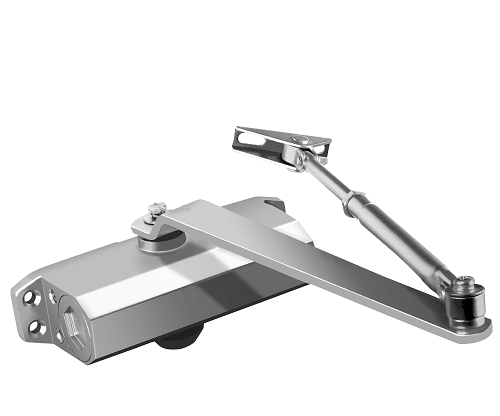
In order to choose a door closer appropriate to your building, you need to consider factors such as:
- Location - External doors require heavier and more robust door closers to allow for weather conditions the door may be exposed to. Internal doors won’t require the same level of resistance, although wind tunnels and ‘slamming’ factors may still exist.
- Door size – A larger or heavier door will require a bigger and stronger door closer with a higher power rating, while smaller, lighter doors only require a door closer at the other end of the scale. Door closers are usually categorised by their power rating, so this is easy to see and understand.
- Building specifications – What are the compliance requirements of the building? This relates to building regulations and fire regulations. You must comply with these, so this may dictate what type of door closer you have to choose.
- Traffic volumes – The frequency of use of doors is a major factor in the suitability of a door closer. You need a door closer that is appropriate for the average number of cycles your door is subjected to. Most door closers are categorised in terms of low, medium and high usage, which should help with this.
When looking at different types of door closer, you are also faced with a number of design considerations. These include:
- Control – What level of control do you need? Some door closers are easier to adjust than others. So if you will need to slow or speed-up the action of the door closer, or the latching speed, make sure this is factored into your thinking. This can also help with matching speed to traffic volumes and to avoid doors slamming.
- Aesthetics – Overhead door closers are very popular in commercial buildings, but are surface-mounted and very visible. Meanwhile, there are more discreet types of door closer, such as floor or spring door closers, these can be concealed in the floor or the door itself, and hence aren’t visible. In a commercial building where aesthetics are important, such as in hospitality settings, retail and maybe some modern office spaces, a less visible door closer may be preferred, while in other settings such as healthcare or education, this is less of an issue and the practical functionality of a door closer is more important. Some door closers do allow you to choose a material and finish colour, so even if you choose an overhead door closer, it can be supplied to match décor and surrounding fittings.
So you can check out our range of door closers at MB Direct and choose from overhead door closers, concealed door closers or spring door closers for your commercial building. These all have multiple functions which can suit the type of building and location you are managing and can ensure you are fully compliant and have a practical and functional building.