What to look for when buying a pocket door kit
The pocket door delivers many practical and aesthetic benefits in a home or a workplace, but it is essential that you choose the right size of kit. This, fundamentally, is more important than choosing the pocket door itself, as one won’t work without the other.
What is a pocket door kit?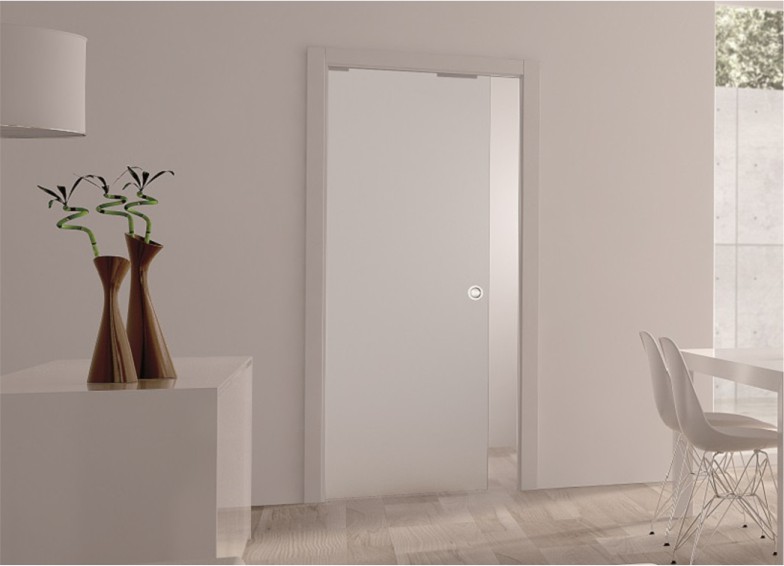
A pocket door works by sliding along an overhead rail into a wall ‘pocket’. But the door is only one element of the overall pocket door system. The kit that makes up the system consists of the steel framework that houses the door and also secures the overhead rail. This steel framework is lightweight and will be supplied in separate sections that are easy to click together, but it has to be the right size. The overhead rail will also have rollers attached which enable the door to travel along the rail into the wall pocket. The kit is completed by a set of jambs, which are separate wooden sections used to maintain the door in a level position and to ensure it runs smoothly, consistently and provides a good seal when closed.
The entire pocket door kit is constructed and then located within a wall cavity, recess or pocket. Ideally this will be within a stud wall construction. This means that the kit needs to be the right size to enable it to match the door opening and stud wall dimensions available to you. So here are the key elements you need to consider when choosing the right pocket door kit.
Internally, a new-build construction will have stud walls in which you can install a pocket door system. Older properties are more likely to have solid internal walls (stone or brick), so you may have to construct your own stud wall adjacent to it, and then plaster this in to disguise it. It is also possible that older properties don’t have straight walls, so you first need to check your dimensions and the physical barriers you are presented with. With an existing wall this might include gas pipework or electrical wiring, for example. This can be diverted, but you need to check for safety reasons.
Even though stud walls are ideal for pocket door kits, they too can differ in size and dimensions, so you need to measure them. Most stud wall constructions are timber, but they can also be metal. Timber can sometimes be roughly produced, and the dimensions might not be exact or consistent, after all, these sections won’t have been cut with the knowledge that someone will at some point be installing a pocket door system. In this respect, a metal stud construction will likely be more accurate and consistent. So check that the gaps and dimensions are accurate in all the key points.
- Measure the whole width of the wall space
The pocket door slides into a wall pocket when it opens, and this means you will need roughly double the width of the door itself to play with, plus an extra allowance in the wall cavity for the framework and for manoeuvring the frame into place, both widthways and in terms of height. This is the dealbreaker in terms of knowing if a pocket door is feasible in this space or not, so measure it out before going any further.
Most door sizes in the UK are standard, so unless the house or building is a very old period property, you should be able to find a pocket door kit that suits. You just need to identify the right one. Door size is the first of three main factors to look at. There are ten common door sizes in the UK ranging from 610mm to 1026mm in width and 1981mm to 2040mm in height. Most product specifications will provide you with details of the kit you need when compared to the door size you have, although choices will obviously include single or double doors.
The frame size equates to the overall maximum dimensions of the wall space needed, ie. as mentioned above, double the door width plus some space to allow for the frame itself and some room to install it. In terms of height, the frame will also need to accommodate the overhead rail above the door, plus the same frame and installation allowance. The frame size should be provided within the specifications, once you have agreed the door size, but you need to check you have the necessary dimensions.
You need to measure the width of the stud wall to establish what thickness of pocket door kit you can accommodate. While these will come in standard thicknesses – usually ranging from 63mm to 100mm – this will include the plasterboard to finish your wall either side of the pocket and some space to ensure the door runs smoothly without hitting obstacles.
Choosing the right size pocket door kit is an essential starting point, and after that you can consider things like pocket door furniture, hardware, accessories and whether a fire door is necessary. So use the specifications provided by MB Direct with all our pocket door systems and choose the right size today.