What is an overhead door closer?
Door closers are mechanisms used to automatically close a door after it has been opened, while many designs also have the ability to control the closing speed to suit the type and volume of traffic in a building, and to control the latching speed, to ensure a door remains securely closed. There are several different types of door closer and these can suit different types of building or locations within a building, but the overhead door closer is perhaps the most common type of door closer.
An overhead door closer is also popularly known as a surface-mounted door closer. This is a mechanical device that is attached to the top of a door frame (ie. overhead) and ensures that the door automatically closes after it has been opened. It also ensures a smooth and controlled closing action. The most common design of overhead door closer is a spring-loaded rack and pinion system, which can be adjusted to control the closing and latching speeds. This is a scissor-arm type of design whereby a main body control box is attached to the top of the door itself, while a pivoted scissor arm is attached to the box and the door frame. Another model of overhead door closer is the cam mechanism, which uses a slide arm to control the door closing action.
The purpose of an overhead door closer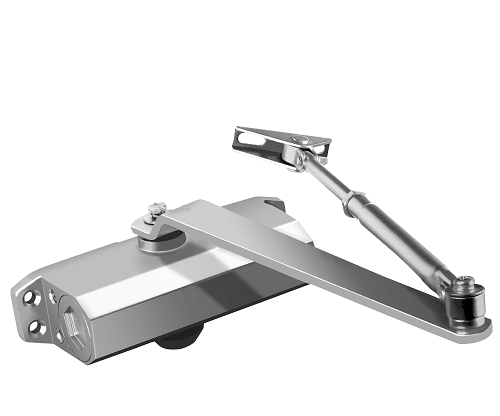
- To automatically close a door after it has been opened.
- To control the closing action so that it doesn’t slam shut or close too slowly.
- To comply with safety regulations in modern buildings.
Overhead door closers can be supplied as light, medium or heavy duty, depending on the size and weight of the door they are controlling, and the volume of traffic the door is going to be exposed to.
The key benefits of an overhead door closer
Although automatically closing a door without any further human intervention is a benefit in itself, this also has consequential benefits in terms of general building management:
- Fire safety – Overhead door closers ensure fire doors automatically close and remain closed, and hence can prevent the spread of fire and smoke.
- Security – Prevent unauthorised access by controlling closing and latching speeds, which in turn ensures the door remains closed and can activate a locking bolt.
- Privacy – Where necessary, a door closer prevents doors being left ajar which can impact on privacy.
- Accessibility – Controlling the closing speed enables people with limited mobility to easily pass through a door, and they can also then continue to pass through without having to turn around and close the door, as this will happen without the need for their physical intervention.
- Energy efficiency – Controlling the closing and latching speeds maintains a door in the closed position and therefore means they can’t be left ajar, which restricts airflow and means warm air stays in a room and cold air can’t travel into the room. This ensures stable temperatures and makes it easier to moderate temperatures in a building. Of course, automatically closing the door and not leaving it open also achieves this on a bigger scale.
- Noise control – Doors that are firmly and securely closed provide a secure barrier to noise travel and hence are useful for boardrooms and meeting rooms where confidentiality is important. But any noise travel can be disruptive to other people. Meanwhile, controlling the closing action also prevents a door slamming, which can be annoying if it is repetitive.
- Durability – A final benefit of the overhead door closer is that they help maintain the door itself and provide it with good durability. The door closer controls the closing action and hence prevents the door being slammed shut or mishandled in any way. This protects the door and its components (handles, hinges) as well as the surrounding door frame and even the plasterwork on the walls.
Where are overhead door closers used
Although overhead door closers are probably the most common type of door closer, they are very visible and can be prominent in a building. For this reason they are mostly used in commercial and public buildings, healthcare facilities and communal residential complexes, in other words, where aesthetic qualities are perhaps not a priority, and these are overridden by those functional and practical benefits listed above.
So overhead door closers are very popular in:
- Office buildings
- Educational facilities
- Hospitals and healthcare settings
- Public buildings
- Anywhere which requires a fire door
Overhead door closers are therefore essential for building safety compliance, but also provide a number of practical benefits which help contribute to traffic flow and building management. You can view our range of overhead door closers and all door closers, at MB Direct today.