What causes a door closer to become stiff?
Door closers perform an important function in a building and are required to be robust and well made, as they can be asked to carry out thousands of repeated cycles in opening and closing doors in busy commercial buildings. It is now an integral part of an interior designer’s job to select the correct type and size of door closer to suit a particular building. This needs to allow for factors such as:
- The door location
- The type of building
- The rate of pedestrian flow
- Security risks
- Safety and energy efficiency needs
- Accessibility needs
Choosing the right door closer is very important as it has an impact on how a building functions, as well as having an influence on these issues listed above. Door closers can be susceptible to maintenance issues through general wear and tear, but also if the wrong door closer is chosen and installed, and you are asking it to perform tasks above its capacity. One of the most common issues this can cause with a door closer is when it becomes stiff, and this leads to a greater resistance when opening and closing the door.
Why does a door closer become stiff?
When a door closer becomes stiff and hard to open it can start to cause a number of issues. Traffic flow can be disrupted, leading to queues to get through a door at busy times. Doors can also become too slow to open and close, which could lead to safety, security and energy efficiency issues. If door closers are very stiff, someone with limited mobility may really struggle to open the door, which could leave them stranded and unable to pass through the door without assistance. So what causes a door closer to become stiff and how can we avoid it?
Door closers can become stiff for a number of reasons, these could be caused by how the door closer is set-up and adjusted, the environment it is located in or incorrect maintenance practices. The main causes of door closer stiffness are:
- Spring tension – The spring tension of door closers can be adjusted so that they cause the right amount of resistance, according to the size and weight of the door and the location it is in. Larger and heavier doors need less tension so they are easier to open, while smaller and lighter doors require more tension so they don’t slam shut accidently or get caught by winds. If this spring tension is set too high for the door’s size and weight this can cause the door closer to be too stiff, making it very hard to open and close.
- Cold environment – Hydraulic door closers contain an internal hydraulic fluid which helps them operate effectively over a long period of time and many thousands of opening and closing cycles. In cold weather, or when doors are exposed to a cold environment, the viscosity of this fluid can increase so that it is much thicker and therefore provides more resistance to the door opening and closing.
- Lack of lubrication – The most popular type of door closers are overhead door closers, which operate by using pivoted arms connected to the door and the door frame. This pivoted arm is opening and closing every time the door is opening and closing, and so it requires lubrication to ease this repeated motion. If there is no lubrication, this mechanical link will seize up and restrict movement, and can cause wear and tear or rust also. This makes the door closer stiff in the process.
- Poor installation – If there is any kind of misalignment between the door and the floor or the frame, this will put strain on the door hardware and make it harder to open. This can occur upon installation, but also during operation if screws have worked loose and the door has dropped.
How to prevent your door closer becoming stiff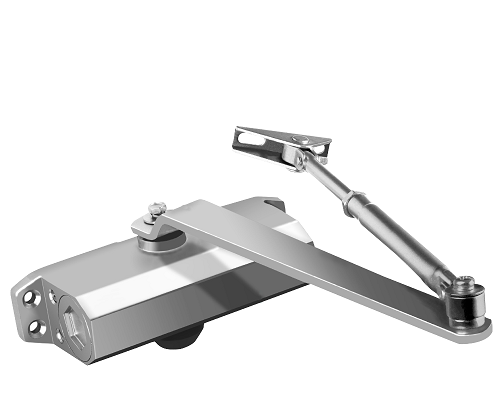
There are a number of things you can do to address these issues and to prevent your door closer becoming stiff. This requires a level of understanding of how the door closer works and how it should be suitably adjusted. It also requires some prior knowledge to ensure the right type of door closer is installed in the first place.
- Lubrication – Make sure the moving parts are well lubricated on a regular basis to prevent friction and resistance. This should include the pivot arms, mechanical joint and the internal valves and springs.
- Cleaning - Periodic cleaning helps to remove debris, dirt and dust that builds up and starts to cause resistance. This can be done during lubrication maintenance.
- Proper adjustments – Make sure the door closer is not overworking and the valves are adjusted to make the door open and close with sufficient force. You could also adjust this at the beginning of winter to allow for the cold weather affecting the hydraulic fluid. Making the door easier to open at this time compensates for the additional resistance caused by the hydraulic fluid becoming thicker.
- Inspect – Keeping a close eye on your door closer during normal operation helps you identify operating issues. This includes fluid leaks, rust, dirt build-up and door misalignment, which can all contribute to the door closer becoming stiff.
Check out our range of door closers at MB Direct.