What are floor door closers?
Door closers are a useful and important element of building design and in recent years have become prominent in a number of practical benefits in building management. Door closers help with safety and security of a building, while they can also assist people with mobility issues, in that they don’t have to worry about turning around to close a door, as it will happen automatically after they pass through it. Door closers are also useful for noise control and heat control, and hence have strong environmental credentials also. But there are many different types of door closers and it is important that architects and interior designers consider the practical characteristics alongside the aesthetic qualities of a door closer, and this is a good example of where floor door closers come into the equation.
Floor door closers – an introduction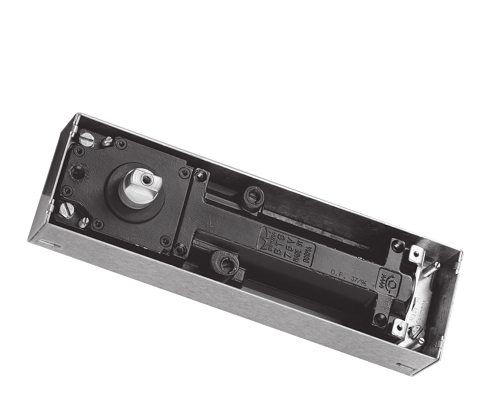
The most popular type of door closer is a surface-mounted overhead door closer that is supplied in two parts; a main body control box attached to the door itself and a pivoted arm which is attached to the main body and the door frame. Door closers are popularly used in commercial buildings, public buildings, healthcare facilities and residential properties. They are effective in controlling the door closing action and speed to achieve a secure latching, but a common issue that people have with this surface-mounted type of door closer is that it is very prominent and conspicuous, and in terms of design quality, elegance and aesthetics are not its strong point. So where appearance is perhaps more important in a door closer, the floor door closer could be a better solution.
A floor door closer – also sometimes called a floor spring closer - is a type of hydraulic mechanism described as a ‘concealed door closer’, which means that it is more discreet and has a low profile, and consequently it can be mounted in a small floor recess beneath the door itself, hence the name. In all other aspects, the floor door closer is as effective as any other type of door closer, in that it can control the closing action and ensure a door latches securely and remains closed, and it can do this with high volumes of traffic. Some models of floor door closer include a spring action and a hold open function, while all models are able to be adjusted so that the closing and latching speed can be changed.
The importance of closing and latching speed in a floor door closer
Using the hydraulic mechanism to adjust the closing speed of a door is an essential feature of a good door closer. There can be a number of factors which affect the closing speed of the door – the size and weight of the door and the environmental conditions of the location are the main ones – but essentially you want the door to close at a speed which suits the volume of traffic and the demographic of the people using the building. For example, you don’t want a door closing quickly in a healthcare facility where elderly people with mobility issues are using the door and need time to pass through it. Equally, in a residential apartment block you don’t want a main entrance door to close slowly, as this could pose a security risk, you want the door to close quickly behind someone entering. Floor door closers can be easily adjusted so the speed is just right for what you need.
Latching speed is also important. This is the final closing action where the door closer intervenes to slow the closing action down to ensure the door latches closed securely. An effective latching means the door is sat in the closed position and is secured by the latch so it won’t open accidentally, it will only open again when someone purposely turns the handle to open the door. This is important for security, noise control and energy efficiency. The latching speed can be adjusted so that a door doesn’t slam shut too fast and bounce out of the latching position, and so it doesn’t close too slowly and not fully engage the latching position.
The benefits of a floor door closer
So the main benefits of a floor door closer are:
- Small and discreet
- Ideal for settings where aesthetics are important, such as hospitality settings (hotels, bars and restaurants), retail stores and modern office buildings
- Capable of coping with high volumes of traffic
- Fully adjustable closing and latching speed
- Can be used with larger and heavier doors as the weight of the door is distributed to the floor
- Able to be used for fire doors where these are needed
- Can be used on both single and double doors
- Popular manufacturers including Briton, Dormakaba, Exidor and Geze.
Check out our range of door closers, including floor door closers, at MB Direct today.