How to stop doors from slamming in offices and commercial spaces
In modern commercial buildings, traffic and people flow is an important factor in how successfully a building operates, and this is carefully considered when a building is first designed by an architect and when it is later fitted out by an interior designer. A building has to work for its occupants. It has to enable people flow and present a platform for people to move and engage with each other as they need to. This is why design elements such as corridors linking different zones and departments are important, and why doors have to function effectively and efficiently in order to enable the required movement of people.
Doors are obviously a fundamental functional element of a building, but they are often under-appreciated in terms of how they can impact on issues such as safety, security, compliance, accessibility, energy efficiency and traffic flow. The issue of doors slamming shut might immediately strike you as simply an irritating noise hazard, but it can also impact on all these separate issues listed above, and in this guide we will explain how this happens, and what you can do to avoid these problems.
Why are doors slamming shut a problem for a business?
A door can slam shut in a commercial building due to draughts and environmental conditions, particularly if the door is close to an external exit. It can also slam shut if the door is too heavy or too much force has been used to close it, or if no control measures have been installed to restrict or regulate the door closing operation. So doors slamming shut can have the following impacts:
- Safety – A door slammed shut unexpectedly, perhaps caused by excessive airflow or a wind tunnel, can strike someone or trap limbs or fingers. It can also damage wall plaster, the door frame and the door itself.
- Security – If nothing is controlling the door speed, the door slamming shut can mean it doesn’t latch properly and therefore bounces open again. This could cause security issues as latching is usually what engages automatic security bolts.
- Compliance – Following on from the above issue, if doors aren’t closed when they are supposed to be, this could be a fire safety issue and can also be a compliance issue for insurance reasons.
- Accessibility – People with limited mobility may not be able to pass through a door comfortably if the door closing speed is not controlled.
- Energy efficiency – Doors slamming shut, not latching and then opening up again can cause heat loss in key locations and airflow which imbalances a stable temperature. This can result in excessive and unnecessary energy usage.
- Traffic flow – Doors closing too quickly can be a hindrance to traffic flow and can cause bottlenecks in high traffic areas, causing queues and inconvenience.
All this is in addition to the issue of repeated noise hazards caused by a door repeatedly slamming shut.
How to prevent a door slamming shut in a commercial business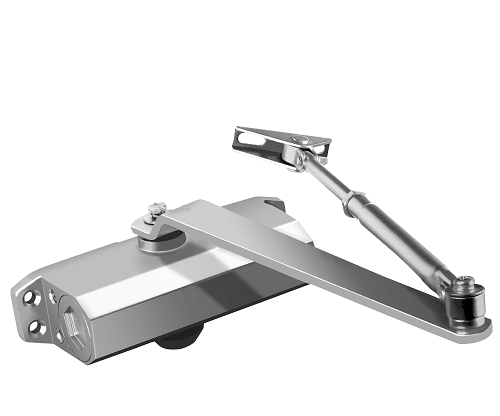
There are two easy solutions for preventing a door slamming shut, depending on what type of door you have:
- Pocket door anti-slam accessory – If you have a pocket door installed, you can retrofit an anti-slam accessory, also known as a soft-close feature. This takes control of the door closing action and ensures it closes under restraint even if excessive force is used initially. Ensuring the door reaches the closed position slowly prevents the issues listed above.
- Door closer – For standard doors, a door closer can be fitted to take control of the closing action and prevent the door slamming. There are many different types of door closer, though the most common is the overhead door closer. This is a hydraulic unit that takes control of the closing arc of the door at a certain point, usually with about 45 degrees of the closing action to go. The closing speed can be adjusted to suit the traffic flow experienced in the commercial building. So in busy, high traffic areas you don’t want the closing speed to be too fast, as people will be continually opening and closing the door unnecessarily. Equally, in quiet and low traffic locations, you don’t want the closing speed to be too slow, as this can cause security and energy efficiency problems as the door is left open too long. There will be some trial and error involved. You can also adjust the latching speed so that the very last section of the closing arc is controlled to ensure the door engages the latch and doesn’t slam shut, or at the other end of the scale, has sufficient force to engage the latch and stay shut.
So installing an anti-slam feature on a pocket door or installing a door closer on a standard hinged door are the best ways to prevent a door slamming in a commercial building. You can check out our range of accessories for a pocket door and our range of door closers at MB Direct.