How to measure for a flush door system - common mistakes to avoid
A flush door system is normally chosen as a feature because of its aesthetic appeal. It is ideal for a modern property such as a hospitality venue, a contemporary retail store or a new-build residential property, but even though a flush door system is more of a visible feature, you still need to take considerable care when choosing the right size. Regular dimensions such as the door width, height and thickness are essential in terms of how easy the installation will be, how well the door will operate and how long it will last for.
It is also important to choose the right door system in terms of room usage and how furniture flows in a room. In this guide we will look at these considerations and establish how you should measure for a flush door system, and which mistakes you should avoid.
What is a flush door system?
Flush door systems have no surrounding architrave and are installed to sit flush with the wall. This results in a ‘clean’ aesthetic with flat lines and surfaces which creates a minimalist look and which appeals to contemporary settings where sleek and elegant aesthetics are important. Flush doors usually have flat surfaces without door panels or mouldings, which helps to maintain this visual appeal. You would normally use flush doors for bedrooms, bathrooms and kitchens in a residential property, though they would suit all interior doors. This is also true of a commercial building where flush doors are popularly used for all interior doors. Flush doors are durable and easy to maintain, and their lightweight nature means they are also easy to install.
Standard measurements for a flush door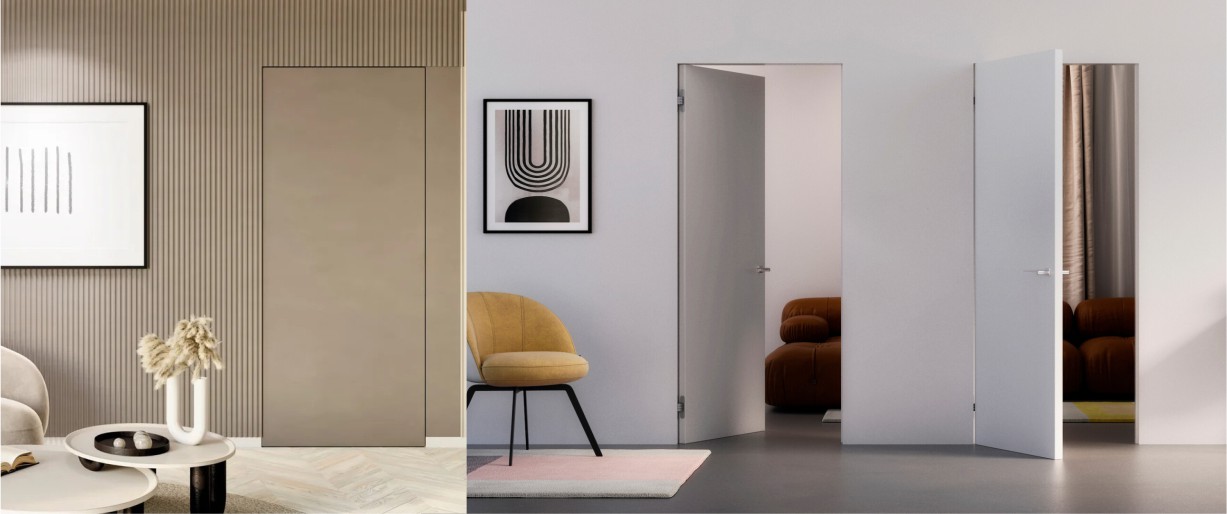
In a residential property door heights usually come in standard sizes, either 1981mm or 2040mm. Doors also come in a range of standard widths, including 610mm to 838mm for 1981mm high doors and 726mm to 926mm for 2040mm doors. Some door widths are more suitable for certain doors, such as narrower doors are more suitable for smaller and more compact low-traffic rooms, such as bathrooms or utility rooms, whereas wider doors are more suitable for bedrooms and more commonly used living spaces, such as a living room or kitchen. This is because traffic is more regular in these areas and you are more likely to be carrying something into these rooms.
You should find that these dimensions are common in modern constructions and therefore can be incorporated easily into your calculations when designing a flush door system install.
In terms of door thickness, standard doors are usually 44mm in thickness for internal doors in high traffic areas, and most flush door kits will work to a stud wall thickness of minimum 63mm, with no maximum.
How to measure for a flush door system
- Measure the dimensions of your door opening carefully.
- Check the height, width and door thickness options against the size charts provided by your supplier.
- Make sure you factor in issues such as hinges, the type of flooring being used, particularly if this hasn’t been installed yet, and the amount of door swing that is required.
- Consider the type of room and whether the door dimensions you have available are going to be suitable for a flush door system.
Common mistakes to avoid when measuring for a flush door system
Of course you need to be accurate in how you measure the dimensions of your flush door system. One common mistake is not being accurate with this and finding you have a door that is not suitable for your opening. Other common mistakes include:
- Overlooking the need for hinges, locks and obstruction-free door movement.
- Not considering installation – You would normally leave a 10mm allowance for movement to ensure the door can be positioned and aligned properly.
- Assuming walls are straight – You shouldn’t assume that all your walls are perfectly vertical and should use the three-point technique to verify this. It is possible that a door opening width is different at the top compared to the bottom.
- Check the configuration required – Most flush door systems can be installed in one of four configuration options, ie. with the handle on the left or right, and opening inwards or outwards. You should confirm how you want the configuration to be designed as this could impact on your dimensions.
- Not allowing for expansion or contraction – Timber doors can swell or shrink depending on their age, where they are located or the temperature or moisture levels in a room. This is completely natural and there isn’t much you can do about it, so you need to allow for this so that doors don’t stick or rub when opening.
Perfect door installation with flush doors from MB Direct
All our product specifications for flush door systems at MB Direct have dimension guides to help you choose the correct size. You can also ask our sales team for advice, but if you have followed this guide and taken care to measure your flush door system correctly check out our range of flush doors and place an order today.