How door closers help control noise between rooms
Door closers provide multiple practical benefits and have become a popular part of the infrastructure and fabric of a commercial and residential building. Noise control is not necessarily a priority when it comes to choosing a door closer for your building, but it is one of the benefits of installing a door closer and is an effective way to reduce the transmission of noise between rooms.
When installing a door closer, people tend to expect common benefits such as:
- Security – A door closer ensures a door closes and engages a locking mechanism.
- Health and safety – A door closer controls the closing action so people don’t get struck by a door closed with too much force, or which catches in a wind tunnel and slams shut.
- Damage – Doors closed with too much force can damage the door, door furniture such as hinges, the door frame or the plaster in surrounding walls, a door closer prevents that.
- Energy efficiency – Ensuring a door is always closed after use reduces the amount of thermal transfer between rooms, also reducing the need to use excessive energy to address that heating loss.
- Accessibility – Controlling the speed of a door closing allows people with accessibility or mobility needs to pass through a door safely.
Noise control is one more benefit provided by door closers, and here we will take an extended look at this and explain how door closers do an effective job in reducing noise transmission.
Noise control – explaining the problem
There are two ways in which noise can be disruptive in a building, whether it is a residential or commercial building:
- Doors slamming – The sound of a door slamming shut can be startling and distracting. And if it happens repeatedly it can be disruptive. This is noise pollution and is caused by a door not being controlled during the closing action. Doors slamming can occur due to wind catching the door, or due to heavy-handed users.
- Noise transmission – Leaving a door open, or allowing it to repeatedly bounce open, allows noise to travel from one room to another. The door acts as a natural barrier to noise transmission, and this can be a nuisance to people working, studying, sleeping or just wanting to live a quiet life.
How does a door closer reduce noise transmission?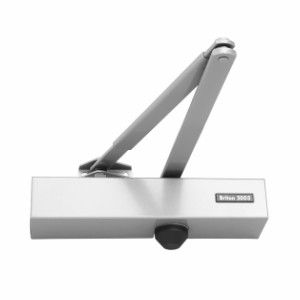
A door closer removes this problem by taking control of the closing speed and the latching action, much like a shock absorber. The latching action is the final part of the closing arc and makes the closing action quiet, slow and soft. Instead of a door slamming shut under force and possibly bouncing out of the closed position, a door will rest in the closed position and engage a latch which ensures it stays there. This is a controlled stop and therefore prevents the door re-opening due to a draft and continually slamming shut and causing a noise hazard.
The door closer also ensures a door automatically closes after each cycle. Using hydraulic force, the door closer applies sufficient pressure to close the door once it has been opened. This overrides any pressure created by wind or someone physically pushing a door closed, and prevents a door being left open by accident. This reduces issues such as security and energy efficiency, but also prevents noise travelling between rooms unnecessarily.
Modern doors are professionally designed, manufactured and installed. This means that a good quality door will have no gaps around the edges of the door and seals will be even and well made. A good quality door made from good quality materials will therefore absorb noise and prevent it travelling through the door as much as possible.
The benefits of a noise-free environment
In a commercial space, reducing noise makes a business compliant in terms of noise hazards, but door closers also manage noise hazards to create a stress-free environment where people can work, focus and be productive. Essentially this is creating a much more professional workplace and helps people manage their daily tasks effectively and efficiently. In a residential space, door closers have a similar effect, in that people want a quiet and peaceful space where they can unwind, or read and study, and of course in which they can sleep.
So door closers have multiple benefits in a commercial or residential space and amongst these, reducing noise transmission is becoming one of the most popular. Check out our range of door closers at MB Direct and see how they can benefit you.