Door closers for care homes and healthcare settings
Managing a care home or healthcare facility is very challenging in terms of considering features such as doors and door closers. This is because you are faced with a wide range of people, including employees, emergency staff, members of the public and people in a residential setting, and people who may have limited mobility and accessibility needs. The challenge therefore is to ensure people can move around the facility in accordance with their mobility needs and abilities, but that this is carefully managed in terms of safety, security and energy efficiency, also remembering that it is a primary objective of the facility to make people feel comfortable and at home.
There is a lot to consider when it comes to fitting out the interior of a care home or healthcare facility with door closers, but there are suitable products available with features which suit this kind of setting and will help you in your pursuit of compliance and effective facility management. In this guide we will outline the specific needs and challenges with regards to door closers in care homes and healthcare facilities, and consider what solutions are most suitable amongst the wide range of door closers available.
The unique door closer requirements of care homes and healthcare facilities
A care home or healthcare facility presents a number of unique challenges in terms of what kind of door closer you need: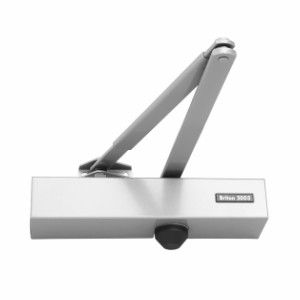
- Privacy – There will be rooms where privacy is essential, so the facility will need door closers in rooms such as bedrooms, consultancy rooms, offices and operating theatres. This ensures that doors close and people are afforded the privacy they need in this kind of environment.
- Security – Door closers are needed to ensure facilities are safe and secure given there are stocks of equipment and medicines on-site and there are vulnerable people in the building, as well as members of the public.
- Safety – It is important that door closers can be controlled to manage the speed at which they open and close the door, and that they don’t provide too much resistance for people who might struggle to open it. This allows people to pass freely through the door without being struck or unbalanced, bearing in mind they may need time and assistance and the widest arc possible to enable other equipment to pass through with them, ie. a wheelchair or other mobility assistance.
- Compliance – Many door closers need to be set-up with a ‘hold open’ facility, or at least speed-adjusted to allow people to safely pass through, but also so they are compliant with fire regulations. Fire doors have to be kept closed to prevent the spread of fire and smoke, but also need to be controlled to allow free passage for the volumes of traffic found in a busy care home and healthcare facility. This includes doors into individual rooms, but more commonly doors in corridors, doors to communal rooms or doors linking different zones or departments of a building. There is a balance to be struck here which is achievable with careful management, to ensure the facility is safe and compliant, and also meets the mobility needs of the people using the building.
What types of door closer are suitable for care homes and healthcare facilities
The most common type of door closer for this type of facility would be an overhead door closer. This is a surface-mounted door closer which is supplied in two parts and attached to the door and the door frame. Linked by a pivoted arm this type of door closer allows the facility manager to carefully control the opening and closing speed, and also the latching speed, which is important for securely latching a door and therefore ensuring privacy and security in this type of building.
An overhead door closer can also have a ‘hold open’ function, as can other types of door closer, such as floor, spring, transom and concealed door closers. These are more discreet types of door closer which are not surface-mounted and hence aren’t visible. These are less common in some care homes and healthcare facilities because there isn’t an onus on the aesthetic appeal of the door closer, but they will be more popular where residents are staying on site, as their more discreet appearance is easy-on-the-eye and more pleasant for people in temporary or longer-term residence. In these types of situations, you don’t want a facility to appear like a hospital, and it needs to appear more like someone’s home, and so a concealed door closer is more appropriate than a visible surface-mounted door closer. These types of concealed door closer are not quite as easy to adjust in terms of closing and latching speed, although they do have this ability. All these types of door closer can be tested to meet the current fire regulations also.
Choosing door closers for care homes and healthcare facilities
So the most important considerations when choosing door closers for these types of environments is that people have the privacy and security they need, the facility meets fire regulations, people can move freely around the building as they need to and any residents feel comfortable and homely in this setting. You can browse our range of door closers at MB Direct and choose the type that suits your needs.