Can door closers help reduce energy loss in buildings?
Managing a commercial building requires attention on a wide range of disciplines, including safety, security and accessibility. A commercial building has to be safe and secure for its users and it has to be practical to use in terms of access and building flow. The energy efficiency of a building is also something that comes under close scrutiny and also links to significant business objectives in terms of cost reductions and environmental management. This is why door closers are often underestimated in terms of the impact they can have on safety, security, accessibility and energy efficiency.
Door closers directly impact on safety and security by ensuring doors are properly closed and latched, so that safety and security features can be engaged. They can be manipulated by adjusting the closing and latching speed, which ensures the door closer matches the type and frequency of traffic using a building. But energy efficiency is another major factor that door closers can now influence, and this is playing a more important role as businesses prioritise energy management and seek to find more ways to reduce their energy losses.
The importance of energy efficiency to a commercial business
For many years businesses have had to prioritise the health and wellbeing of their employees. This means providing a safe and comfortable workplace as a basic duty. While this initially involved compliance with a raft of health and safety regulations, and still does, it has increasingly focused on employee wellbeing in terms of air quality and workstation comfort. More and more organisations install air conditioning as a cost-effective measure in regulating and improving air quality and providing stable temperatures.
Air conditioning, and any form of heating and ventilation, involves mechanical systems which are expensive to run, so any benefits gained need to be cost-effective for the business. While the priority of HVAC systems such as these are the health and wellbeing of employees, the systems also need to be justified from a cost point of view, and this means managing them so that they are well maintained, operate efficiently and energy isn’t wasted. Commercial businesses are also striving to improve their own energy performance, so all areas of a business need to be looked at to ensure energy is being used wisely and isn’t being wasted. This is where door closers play an important part.
How does a door closer help with energy efficiency?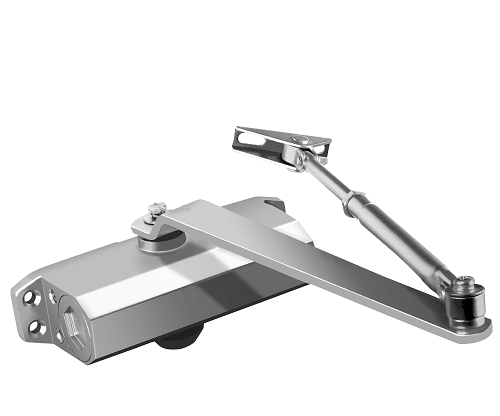
Door closers have the express purpose of making sure a door closes every time it is opened, and also that it remains closed. For this reason, it is important that the closing and latching speed of a door closer is suitably adjusted, this can have practical benefits but is also important for energy efficiency.
- Stable temperatures – Making sure that doors are always closed helps to prevent warm air escaping and being replaced by cold air. Or vice versa in summer time. This maintains a stable temperature that is comfortable for all the people using the building, and therefore doesn’t put unnecessary demands on energy sources.
- Maintain temperature-controlled areas – In some commercial buildings, such as hospitals, labs and research centres, certain rooms have to be maintained at a specific temperature. Door closers help to maintain these temperatures, and have a particular benefit where there might be a large temperature differential from one area to another.
- Air circulation – Door closers also prevent air circulation issues, such as cold air coming in from outside, or warm air rising to the top of a building at times where cooler air is wanted.
- Secure closing – Even if a door is left slightly ajar, this can generate draughts and airflow and therefore heat loss. Door closers can be adjusted to ensure that a door properly latches when closed. This means the latch is engaged and will keep the door in the closed position. Otherwise, the door may drift ajar and enable heat loss. This is also important in a door being able to engage security bolts.
- Heat loss – If a door closes too slowly it can enable heat loss unnecessarily. It is possible to adjust door closers so that the door closes at a speed appropriate to how much traffic there is in a building and what type of people are using the building. This prevents doors being left open longer than is necessary. For example, you would adjust doors to close slower in a healthcare facility, or where older people are likely to be using a building.
- Reliability – Put simply, we can’t rely on people to close a door every time they use it. This will inevitably lead to doors being left open from time to time. Door closers guarantee that a door will be closed and heat loss will be minimised, and hence they ensure the task is consistent and effective.
- Compliance – Increasingly, commercial buildings are having to meet strict environmental targets in terms of energy efficiency. Door closers help reduce energy loss and hence can help a building secure the minimum rating it needs for regulatory compliance. This can make the difference between whether a commercial building can be let to tenants or not.
So door closers play an important role in managing the energy efficiency of a building and installing them can be a significant step in managing energy usage in a commercial building. So check out our range of door closers at MB Direct.